
 July 28, 2026
How to Choose the Right RPO Model for Global Hiring
Posted by: Category:blogs
Table of Contents :
Table of Contents
Choosing the right Recruitment Process Outsourcing (RPO) model makes global hiring much more efficient. The ideal RPO model aligns with your hiring volume, business goals, budget, and talent acquisition strategy, enabling faster hiring, higher-quality candidates, and scalable recruitment across international markets.
As businesses navigate an increasingly competitive global talent market, hiring agility has become a key differentiator. 70% of business leaders say their primary competitive strategy over the next three years is to be fast and agile.
Different labor laws, cultural expectations, sourcing channels, and hiring timelines require a structured recruitment approach. That’s why many organizations rely on recruitment process outsourcing services to streamline global recruitment while maintaining quality and compliance.
What Is Recruitment Process Outsourcing (RPO)?
Recruitment Process Outsourcing (RPO) is a hiring solution where an organization outsources all or part of its recruitment activities to a specialized recruitment partner. An RPO provider manages the overall recruitment process—from workforce planning and employer branding to candidate sourcing, interviews, onboarding support, and recruitment analytics.
Modern RPO services act as an extension of the HR team, helping organizations build a sustainable talent acquisition strategy while improving hiring efficiency.
Why Businesses Need an RPO Model for Global Hiring
Global hiring introduces complexities that internal recruitment teams may struggle to manage consistently.

An effective RPO model helps organizations:
- Access wider international talent pools
- Improve candidate experience
- Maintain hiring compliance across countries
- Fill specialized and hard-to-find positions faster
- Standardize recruitment processes globally
Types of RPO Models
Different businesses require different levels of recruitment support. The most common RPO models include:
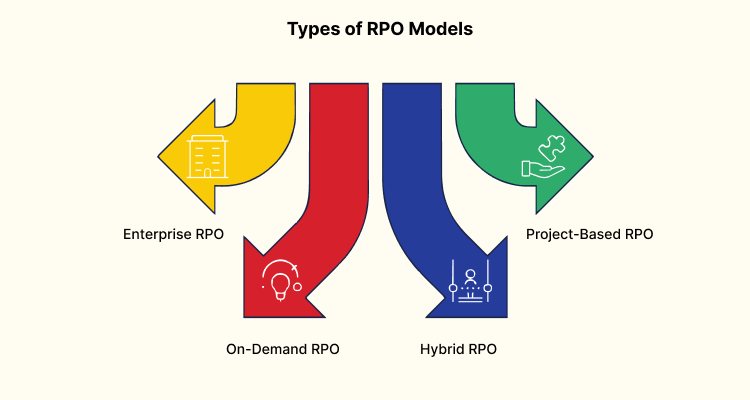
1. Enterprise RPO
Enterprise RPO manages the organization’s complete recruitment lifecycle.
Best for:
- Large enterprises
- Continuous hiring
- Global workforce expansion
2. Project-Based RPO
Designed for short-term hiring initiatives such as:
- New office launches
- Seasonal hiring
- Digital transformation projects
- Mergers and acquisitions
3. On-Demand RPO
Provides recruitment support whenever hiring demand increases.
Ideal for:
- Growing businesses
- Startups
- Mid-sized organizations
4. Hybrid RPO
Combines internal recruitment with outsourced recruitment functions.
Suitable when companies want flexibility while retaining strategic hiring control.
Comparing Different RPO Models
| Feature | Enterprise RPO | Project RPO | On-Demand RPO | Hybrid RPO |
|---|---|---|---|---|
| Recruitment Scope | End-to-end | Project-specific | As needed | Shared responsibility |
| Hiring Volume | High | Medium to High | Variable | Flexible |
| Best For | Global enterprises | Expansion projects | SMEs and startups | Growing organizations |
| Scalability | Excellent | High | Moderate | High |
| Cost Efficiency | High for continuous hiring | Moderate | Flexible | Balanced |
| Internal HR Involvement | Low | Moderate | Moderate | High |
Factors to Consider When Choosing the Right RPO Model
Selecting the right RPO solution requires evaluating both current and future hiring needs.

A company must consider the following factors:
Hiring Volume
Determine whether hiring is ongoing, seasonal, or project-specific.
Geographic Expansion
International hiring requires expertise in regional labor markets, employment laws, and cultural differences.
Budget
Compare long-term recruitment costs against internal hiring expenses.
Hiring Speed
Organizations experiencing rapid growth often require scalable recruitment support.
Technology
Look for providers using modern ATS platforms, AI-powered sourcing tools, and recruitment analytics.
Industry Expertise
Industry-specific recruiters often deliver better candidate quality, particularly for healthcare, IT, engineering, finance, and life sciences.
Employer Branding
A strong RPO provider enhances the candidate’s experience while strengthening the employer’s reputation.
Signs Your Business Needs an RPO Partner
You may benefit from RPO staffing if:
- Hiring takes longer than expected.
- Candidate quality is inconsistent.
- The workload is overwhelming your HR team.
- You’re expanding internationally.
- High-volume hiring is becoming difficult.
- Critical positions remain vacant for extended periods.
- The technology used in recruitment is outdated.
Businesses experiencing these challenges often partner with experienced RPO staffing companies to improve hiring outcomes.
How to Evaluate an RPO Provider
Not every provider delivers the same level of expertise.
When evaluating potential partners, consider:
- Global recruitment experience
- Industry specialization
- Technology capabilities
- Compliance knowledge
- Recruitment metrics and reporting
- Candidate experience strategy
- Client success stories
- Scalability
- Service flexibility
- Communication and support
Also ask questions such as:
- How do you measure recruitment success?
- What industries do you specialize in?
- Which countries have you recruited in?
- How do you ensure hiring compliance?
- What recruitment technologies do you use?
Comparing several best RPO companies helps ensure you choose a provider that aligns with your business goals.
Benefits of Selecting the Right RPO Model
Choosing the right RPO service provider delivers long-term value beyond filling vacancies.
Advantages include:
- Faster hiring cycles
- Lower recruitment costs
- Improved quality of hires
- Better candidate experience
- Enhanced employer branding
- Access to global talent pools
- Scalable hiring processes
- Recruitment compliance
- Actionable hiring analytics
- Stronger workforce planning
Businesses that integrate RPO and staffing solutions into their hiring strategy often achieve greater recruitment efficiency while allowing internal HR teams to focus on strategic initiatives.
Choosing the right RPO model is a strategic decision that directly impacts hiring success, workforce quality, and business growth. As global talent acquisition becomes increasingly competitive, organizations need recruitment partners capable of adapting to changing workforce demands while delivering measurable hiring outcomes.
Ready to strengthen your global hiring strategy? Contact our team at (972) 929-6600 or write to sales@imcsgroup.net
Frequently Asked Questions
- Why is RPO beneficial for global hiring?
RPO provides access to international talent networks, local market expertise, compliance support, and scalable recruitment processes that improve hiring speed and candidate quality.
- What is the difference between an RPO provider and a staffing agency?
A staffing agency primarily fills open positions, whereas an RPO provider manages all or part of the recruitment process, including strategy, sourcing, employer branding, technology, analytics, and ongoing workforce planning.
- Which RPO model is best for high-volume hiring?
Enterprise RPO is generally the best choice for organizations with continuous, high-volume hiring needs because it offers end-to-end recruitment management and maximum scalability.
- Can small and medium-sized businesses benefit from RPO?
Yes. Small and medium-sized businesses can use on-demand or project-based RPO models to access experienced recruiters, reduce hiring costs, and scale recruitment without expanding internal HR teams.
- How does RPO improve the quality of hires?
RPO providers leverage specialized recruiters, advanced sourcing technologies, structured screening processes, and global recruitment analytics to identify candidates who are a stronger fit for both the role and the organization’s long-term objectives.

Share


